
The Power of Comparison in Massage Therapy Learning
Introduction
Comparison tasks are active learning exercises where learners examine related concepts to identify similarities, differences, and connections. Rather than focus on isolated facts, these tasks encourage learners to analyze why similarities and differences matter when working with clients.
This article covers how comparison tasks benefit learning, provides visual diagrams, and offers practical classroom ideas. We’ll also look at how comparison thinking appears in MBLEx content and exam questions.
How Do Comparison Tasks Benefit Learning?
Comparison tasks engage deeper cognitive processes than simple recall or recognition. First, they activate prior knowledge. Learners must retrieve what they already know about each concept before they can compare them. This retrieval strengthens memory and reveals gaps or misconceptions.
Next, comparison requires elaborative processing. Learners analyze features, functions, and contexts, which forces the brain to encode information more richly. Instead of memorizing definitions, students build interconnected knowledge structures.
Comparison tasks also support schema refinement. As learners notice subtle differences and overlaps, they adjust their mental frameworks by clarifying categories, correcting errors, and organizing information more efficiently. This is especially valuable when students encounter concepts that look similar on the surface but function differently in practice.
From a constructivist perspective, comparison tasks encourage learners to build meaning rather than receive it passively. The act of deciding how two ideas relate promotes metacognition, in which students become more aware of how they think, where confusion arises, and what distinctions actually matter. For example, when students wrestle with questions like “How is Swedish massage different from myofascial release in intent and application?” they’re actively constructing knowledge.
Finally, comparison tasks enhance learning transfer. When students practice distinguishing between concepts in the classroom, they’re better prepared to recognize distinctions in real clients, where presentations are rarely textbook-clear. For instance, a client doesn’t walk in saying, “I have bicipital tendinopathy.” They say their shoulder hurts when they reach overhead. The therapist who has practiced comparing shoulder conditions, such as rotator cuff strain vs. impingement vs. biceps tendon issues, is far better equipped to assess, reason, and adapt their treatment approach.
Common Diagrams Used for Comparison Tasks
Educators use a variety of simple visual diagrams to support comparison tasks. Each structure guides learners to notice different types of relationships between concepts.
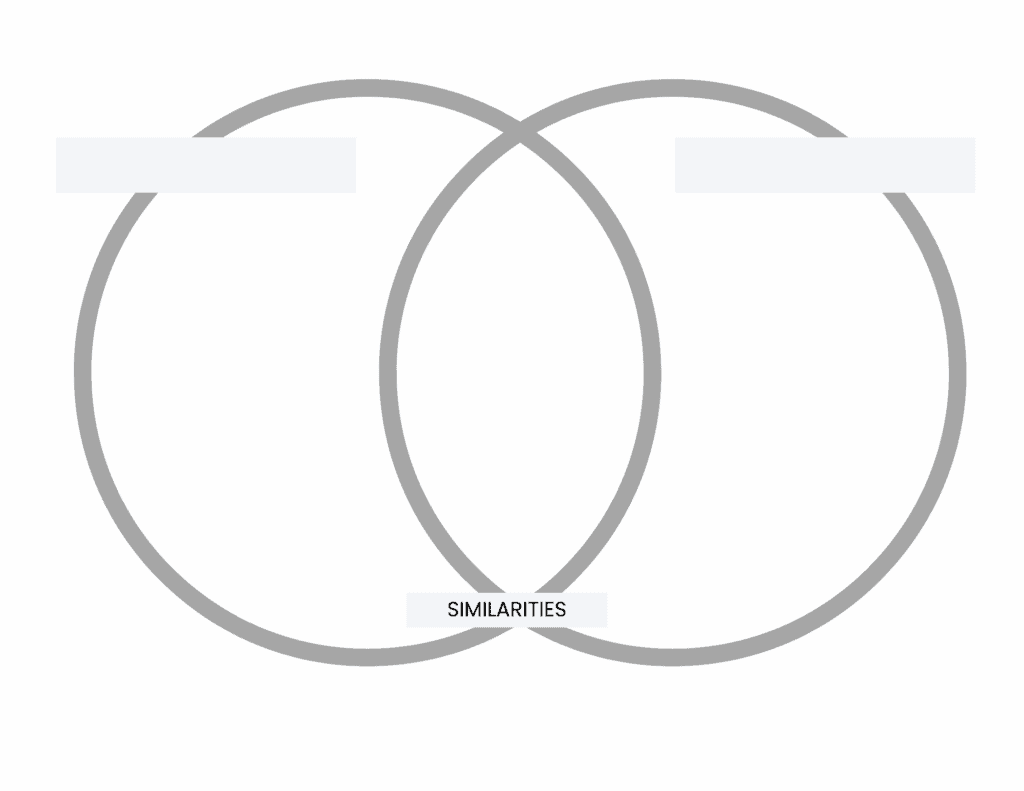
Venn Diagrams (top left) highlight both similarities and differences. Overlapping areas help learners identify shared characteristics, while outer sections emphasize distinctions. Venn diagrams work best when concepts have meaningful overlap and students need to clarify what is common versus unique.
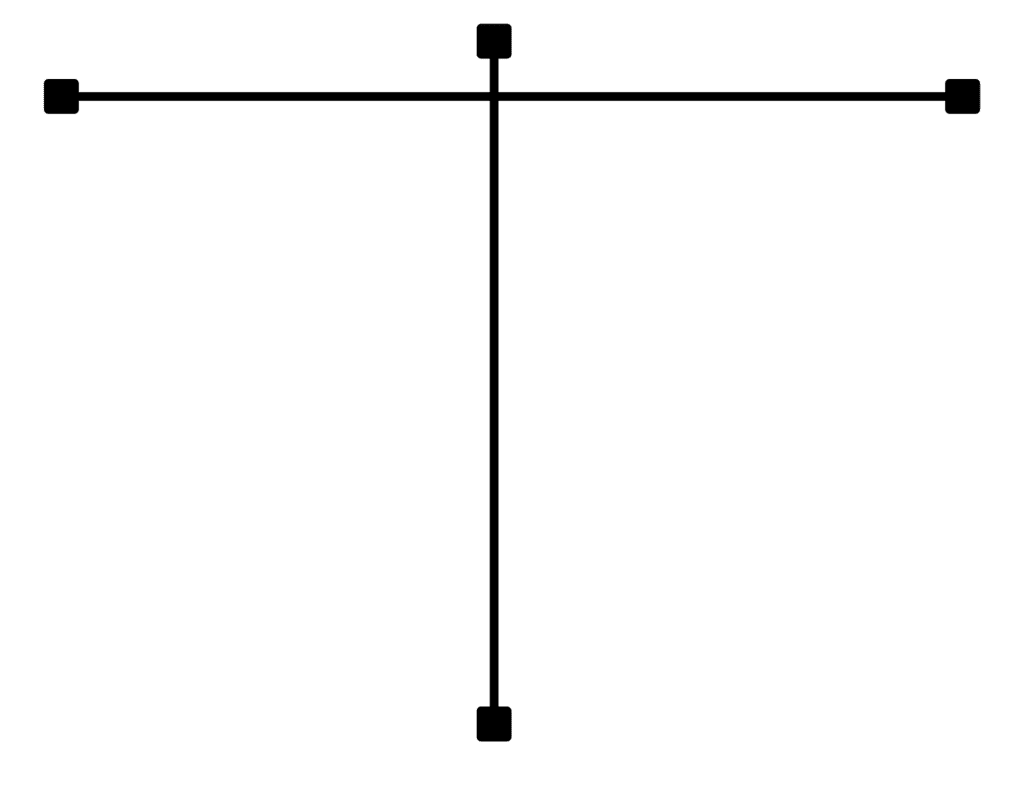
T-Charts (top right) place two concepts side by side for direct comparison. This format encourages clear contrast and is especially useful when learners need to distinguish between closely related ideas, such as techniques, conditions, or roles, without emphasizing overlap.
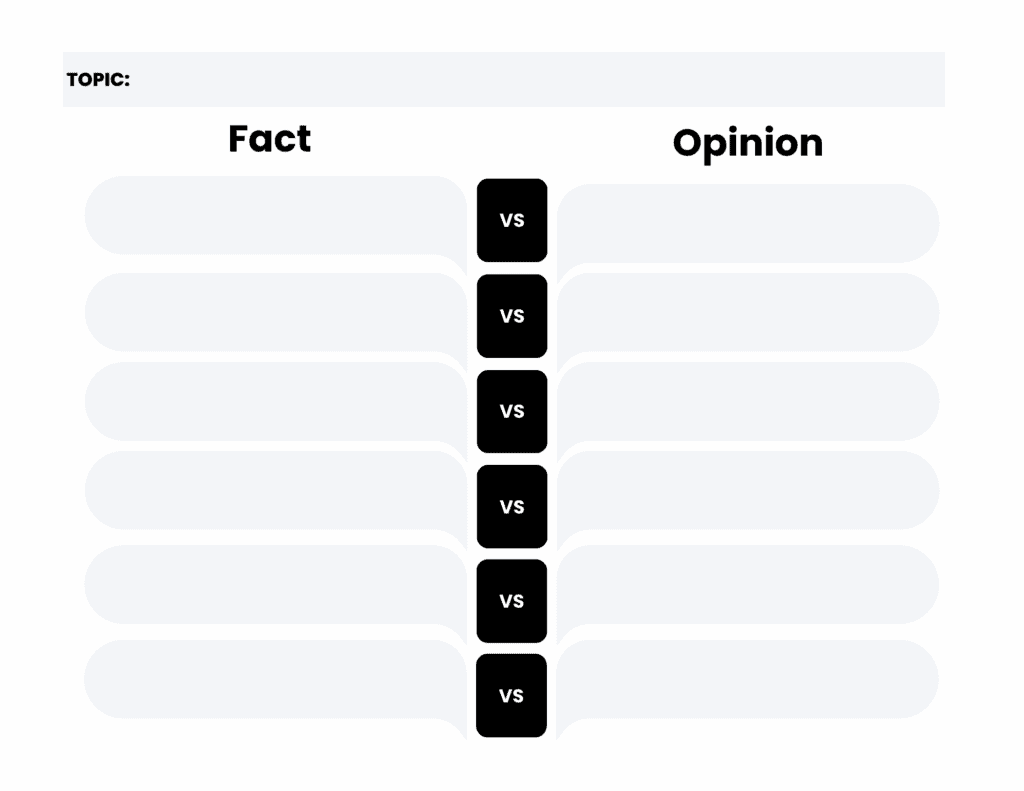
Fact vs. Opinion (bottom left) Charts help learners separate objective information from subjective interpretation. These diagrams support critical thinking, ethical reasoning, and professional communication by reinforcing evidence-based distinctions.
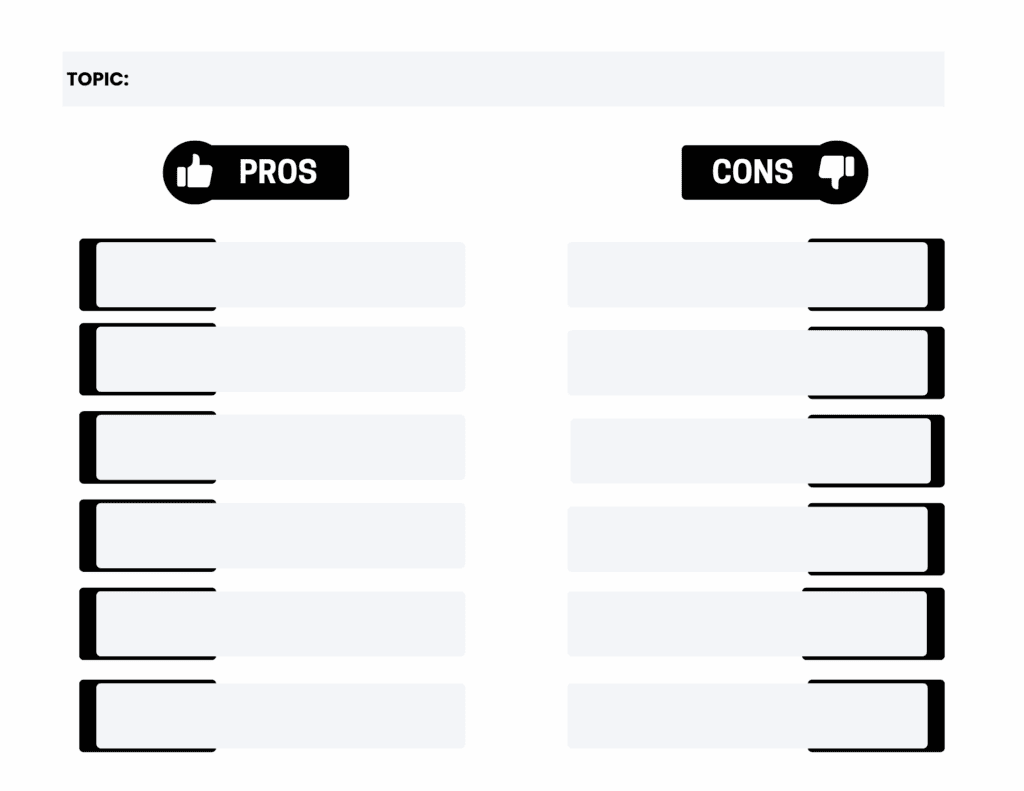
Pro vs. Con Charts (bottom right) organize the advantages and limitations of an approach, technique, or decision. They are particularly effective for treatment planning, ethical dilemmas, and business considerations that require weighing trade-offs.
Comparison Tables or Matrices allow multiple criteria to be compared across two or more concepts. These are useful when learners need to analyze complex material systematically, such as assessing conditions, techniques, or client scenarios across several variables.
Together, these visual tools guide analytical thinking by organizing information clearly, easing mental load, and making relationships between ideas easier to understand and recall. They also support all comparison types below.
Easy Comparison Tasks for Massage Education
Comparison tasks can be designed in many ways, but they are most effective when they mirror how massage therapists actually think in practice. The comparison types below reflect common points of confusion and decision-making in massage education and provide an easy entry point for massage educators new to comparison activities.
Structure vs. Structure
Have students compare two anatomical structures that are commonly confused, such as the upper trapezius and levator scapulae. Points to compare include attachments, actions, palpation differences, referral patterns, and clinical relevance.
Technique vs. Technique
Ask students to compare manual techniques to clarify their differences, such as myofascial release and neuromuscular therapy. Points to compare include therapeutic intent, indications, contraindications, pace, technique effects, use of lubricant, when to choose the system, and client experience.
Condition vs. Condition
Ask students to compare conditions or pathologies to sharpen their clinical reasoning ability. For example, they might compare thoracic outlet syndrome with cervical radiculopathy, acute inflammation with chronic inflammation, or hypertonic muscles with hypotonic muscles. Points of comparison might include symptom patterns, aggravating factors, contraindications, treatment approaches, or session adaptations.
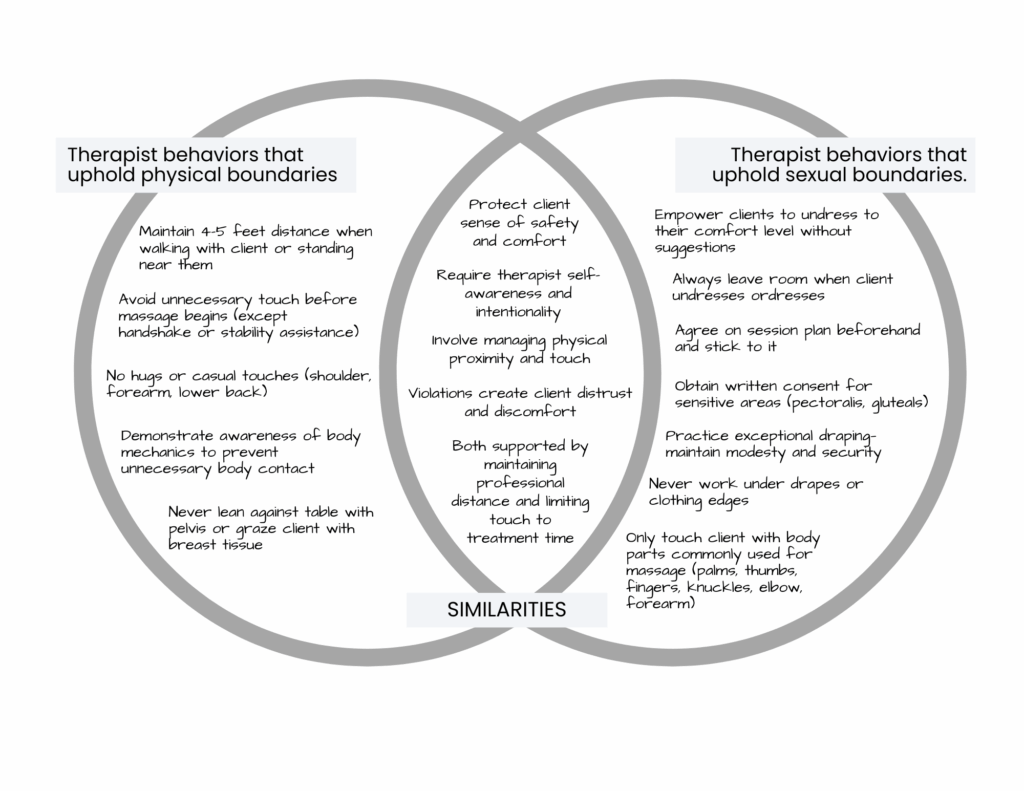
Appropriate vs. Inappropriate Therapist Behaviors or Treatment Choices
Ask students to compare therapist behaviors or treatment choices in scenarios where the therapist’s behaviors are ethical or unethical, or beneficial or harmful. This practice reinforces professional decision-making and judgment.
Example Comparison Task: Structure vs. Structure
Have students compare two anatomical structures that are commonly confused, such as the upper trapezius and levator scapulae. This activity works well with a T-chart.
Activity Format:
- Assign students to work in pairs with a T-chart.
- Give them 7-10 minutes to compare upper trapezius and levator scapulae across the following criteria: attachments, actions, synergists, antagonists, dysfunction.
- Have pairs share one key finding with the class
- Facilitate a brief discussion: “What surprised you? Where did you get stuck? How does this distinction change your treatment thinking?”
What to listen for: Students often discover they’ve been confusing these muscles in practice or realize why certain palpation attempts haven’t worked. These moments of recognition indicate the comparison is working and that students are refining their schemas and connecting classroom knowledge to hands-on experience.

How Comparison Shows Up on the MBLEx
Comparison is a thinking skill embedded throughout the MBLEx. Many questions ask students to distinguish between similar structures, techniques, conditions, or professional responses and determine which difference matters most in a given scenario. Rather than testing isolated definitions, the exam often rewards the ability to apply context, make sound judgments, and choose the most appropriate option among closely related possibilities.
The examples below are organized to make that comparison process visible. Each section begins with an MBLEx content category, followed by common concepts within that category that are frequently compared or confused. Sample multiple-choice questions, then show how comparison appears in exam-style scenarios, highlighting how subtle distinctions are used to test clinical reasoning, safety, and professional judgment. In all the example questions, the correct answer is the first bullet.
Anatomy & Physiology
Examples of comparison targets include skeletal muscle versus smooth muscle, arteries versus veins, blood cell types, and organs by system. Questions might look like this:
A massage student is reviewing the tissues primarily responsible for posture and intestinal movement. Which comparison best explains the different ways massage interacts with these tissues?
- Skeletal muscle is under voluntary control, while smooth muscle functions involuntarily
- Skeletal muscle contracts more slowly than smooth muscle during functional activity
- Smooth muscle generates stronger contractions than skeletal muscle during movement
- Smooth muscle attaches directly to bones, while skeletal muscle supports internal organs
A client presents with prominent superficial vessels in the lower extremities. Which comparison is most relevant when determining appropriate massage pressure?
- Veins have thinner walls and lower internal pressure than arteries
- Arteries carry oxygenated blood while veins carry deoxygenated blood
- Veins are typically deeper, while arteries are superficial
- Arteries control systemic flow while veins control local flow
During massage application, a student applies a technique in the wrong direction. Which comparison between muscle attachments would correct this error?
- Origins are generally more proximal, while insertions are more distal
- Insertions are larger than origins in muscle structure
- Origins shorten during eccentric contraction, while insertions lengthen
- Insertions determine the type of joint crossed
Kinesiology
Examples of comparison targets include things like concentric versus eccentric contraction, stabilizers versus prime movers, joint end-feel, and synergists versus antagonists.
A therapist assesses a client’s elbow at the end range during passive movement. Which comparison best explains the difference between an open-packed position and a close-packed position?
- An open-packed position allows greater joint play
- An open-packed position produces a hard end feel
- A close-packed position increases accessory motion
- A close-packed position removes ligament tension
A therapist passively moves a client’s knee to the end of its range of motion. Which best distinguishes a normal capsular end feel from a normal soft tissue end feel?
- Capsular end feel is firm and elastic
- Capsular end feel is abrupt and painful
- Soft tissue end feel is firm and elastic
- Soft tissue end feel is present only in weight-bearing joints
A client slowly lowers the arm from shoulder abduction under control. Which best describes the muscle action occurring?
- Eccentric contraction lengthens the muscle while controlling movement
- Concentric contraction lengthens the muscle against resistance
- Isometric contraction produces joint motion without length change
- Synergistic contraction replaces prime mover activity
A practitioner observes that a client demonstrates an adequate range of motion but has difficulty sustaining weight-bearing tasks. Which comparison best explains this presentation?
- Mobilizers support movement, while stabilizers support joint control
- Mobilizers support stability, while stabilizers support ROM
- Stabilizers are minimally active during low-load postural demands
- Mobilizers are primarily active during prolonged isometric activity
Pathology & Special Populations
Examples of comparison targets include acute versus chronic inflammation, local versus systemic conditions, high-risk versus low-risk pregnancy, sprain versus strain, and other similar conditions. Question examples are:
A client presents with redness, swelling, and warmth following a recent injury. Which comparison is most important for massage planning?
- Recognizing the difference between acute and chronic signs
- Knowing that chronic inflammation presents with higher pain
- Acute inflammation indicates permanent tissue damage
- Chronic inflammation resolves more quickly than acute inflammation
A therapist works with one client who has a localized tendon injury and another with a systemic autoimmune condition. Which comparison guides appropriate treatment decisions?
- Local conditions affect specific tissues, systemic conditions affect the whole body
- Systemic conditions resolve faster than local conditions, which are often chronic
- Local conditions require deeper work, systemic conditions require lighter work
- Systemic conditions respond best to neuromuscular treatment, and local conditions to Swedish massage
A practitioner confuses ligament and muscle injuries during assessment. Which comparison best clarifies the difference?
- A sprain affects ligaments; a strain affects muscle
- A strain affects joints; a sprain affects muscle tissue
- Sprains heal faster; strains heal slower
- Strains affect the upper body; sprains affect the lower body
Benefits & Effects of Massage
Examples of comparison targets include things like mechanical versus reflexive effects, physiological versus psychological effects, and short-term versus long-term effects. Question examples are:
A practitioner explains to a client that some effects of massage result from direct pressure on tissues, while others result from reflexive responses. Which statement best explains how these effects occur?
- Mechanical effects alter tissue structures, while reflexive effects involve the nervous system
- Direct tissue pressure controls relaxation and excitement levels
- Neural responses are influenced by the client’s attitudes to temperature
- Mechanical effects alter superficial tissues, while reflexive effects alter deep tissues
A client reports improved sleep and reduced stress after massage sessions. Which statement best explains these outcomes?
- Psychological effects influence the nervous system
- Physiological effects alter tissues and systems
- Psychological effects occur during the length of the session
- Physiological effects depend on sympathetic activation
A client experiences immediate relaxation but limited lasting pain relief. Which comparison best explains this response?
- Short-term benefits occur quickly, while long-term benefits develop over time
- Long-term benefits require deep pressure, while short-term benefits require light pressure
- Short-term benefits indicate ineffective treatment, while long-term benefits indicate effective treatment
- Long-term benefits occur only through multiple and consistent sessions
Client Assessment & Treatment Planning
Examples of comparison targets include subjective versus objective information, signs versus symptoms, indications versus contraindications, and differentiation between closely related soft-tissue pathologies. Question examples are:
During intake, a client reports pain intensity while the therapist observes swelling. Which statement best describes these findings?
- Both subjective and objective information are important
- Client reports are less reliable than therapist assessments.
- Range of motion assessment is more reliable than posture assessment
- Therapist observations are usually faulty and lead to poor outcomes
A practitioner palpates increased tone and tenderness in the upper trapezius and levator scapulae during assessment. Which muscle group is most likely to demonstrate inhibition based on this finding?
- Deep neck flexors and lower trapezius
- Sternocleidomastoid and upper trapezius
- Levator scapulae and rhomboids
- Pectoralis major and latissimus dorsi
During postural assessment, a practitioner notes shortened pectoralis major and upper trapezius muscles. Which finding would most likely accompany this presentation?
- Weakness in the lower trapezius and deep neck flexors
- Increased strength in the rhomboids and serratus anterior
- Hypertonicity in the latissimus dorsi and teres major
- Limited hip extension due to iliopsoas tightness
A practitioner assesses a client who reports numbness and tingling in the hand that increases when the arm is elevated overhead. Postural assessment reveals rounded shoulders and a forward head position. Palpation identifies tight scalenes and pectoralis minor. Which condition best explains these findings?
- Thoracic outlet syndrome involving neurovascular compression
- Cervical radiculopathy caused by nerve root irritation
- Rotator cuff tendinopathy affecting shoulder stabilization
- Carpal tunnel syndrome involving median nerve compression
Ethics & Professional Practice
Examples of comparison targets include things like physical versus psychological boundaries, informed consent versus implied consent, ethics versus laws, personal ethics versus professional ethics, and ethical therapist behaviors versus unethical therapist behaviors. Question examples are:
A practitioner provides in-home sessions and chooses to wear jeans and a rumpled T-shirt because they value personal comfort and authenticity. A new client appears hesitant when the practitioner walks in. Which response best reflects appropriate ethical reasoning?
- Professional ethics supersede personal ethics in client-practitioner situations
- Personal comfort is an important factor in maintaining practitioner effectiveness
- Practitioner authenticity is more important than outdated norms
- Dress standards apply only in clinical or spa settings
A practitioner assumes the client knows what to expect during a massage session and is confused when the client lies on the massage table, fully clothed, on top of the linens. Which ethical mistake led to this situation?
- The practitioner did not follow protocols related to informed consent
- The practitioner did not follow protocols related to implied consent
- The practitioner did not follow protocols related to ethical business practice.
- The practitioner did not follow protocols related to emotional boundaries
A practitioner greets a returning client in the reception area and briefly rubs the client’s shoulders while making small talk. On the way to the session room, the therapist rests a hand on the client’s low back. These practitioner behaviors are consistent with:
- Physical boundary violations
- Client ownership violations
- Emotional boundary violations
- Client autonomy violations
In Closing
Comparison tasks help massage students move beyond memorization toward meaningful understanding and sound clinical judgment. By learning to recognize similarities, differences, and context, students build the kind of flexible thinking required for real client care—not just correct answers on an exam. Because comparison is woven throughout the MBLEx, practicing this skill also prepares learners to interpret exam questions more accurately and respond with confidence.
Start small: choose one comparison task from this article and try it in your next class. Notice what questions students ask and what distinctions they struggle to articulate because these moments reveal exactly where comparison thinking is most needed. As students practice comparing structures, techniques, conditions, and professional scenarios, they develop the analytical habits that define competent, thoughtful practitioners.
When educators intentionally include comparison activities in their teaching, they support deeper learning, safer practice, and a smoother transition from student to professional therapist.
Related Posts

Keep Q&A on track in massage classrooms by balancing participation and effectively handling disruptive questions....

Active learning begins where lectures end. Lectures introduce students to new concepts. Active learning requires...

If you've ever watched a student freeze when asked how they'd approach a client with...